
A few weeks ago, ChatGPT Ads launched in beta in Ireland. I was excited to try it. Resisting the urge to jump straight in, I scoured the web for insight, assimilated what I could, and then got started.
If the first two hours are anything to go by, ChatGPT Ads will be the greatest advertising tool we have ever used. Within that time, we spent €20 and received a legitimate digital marketing enquiry which, at the time of writing, looks very likely to turn into a new client.
An encouraging start, but of course one swallow does not make a summer. One enquiry does not establish whether a channel will be profitable, and it certainly does not mean every business should expect the same result.
At SWOT Digital, we have been working through our own campaigns and asking the questions we would ask before recommending an advertising channel to a client. Who can we reach? What can we measure? What can we change when something is not working?
There is an opportunity here. There are also limitations that Irish businesses should understand before spending their money.
When did ChatGPT Ads become available in Ireland?
OpenAI began testing ads in the United States on 9 February 2026. It announced its European expansion on 18 August, with the rollout beginning the following week. Self-service Ads Manager access opened across those European markets on 31 August 2026, with Ireland included in the availability list. So this is still a relatively new option for Irish advertisers.
A paid route to visibility, even when you do not feature organically
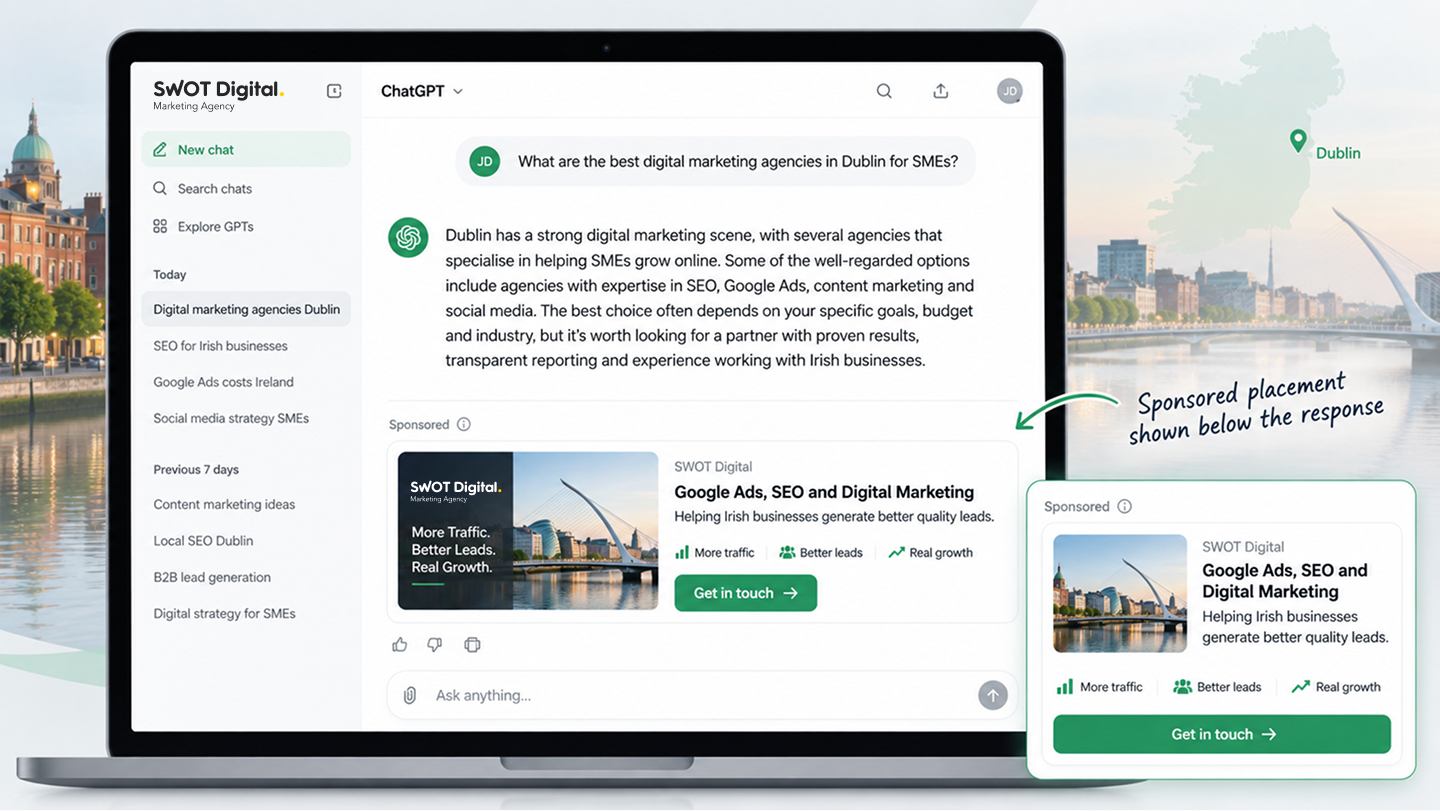
ChatGPT Ads are sponsored placements that can appear below a response, with advertising copy, an image and a link to the advertiser’s website. They are separate from the answer itself.
This is similar to the distinction between Google Ads and organic search results. Paying for Google Ads does not improve where you rank organically. It simply gives you another route to a potential customer’s eyeballs.
How does ChatGPT decide which ads to show?
The system considers several signals, including the context and intent of the conversation, the ad copy, and the landing page. Advertisers can also provide what OpenAI calls “context hints” to explain when their offering may be relevant. These are not exact match keywords.
You cannot simply choose a question such as “Who is the best digital marketing agency in Dublin?” and guarantee that your ad will appear when somebody asks it. The context hints help ChatGPT understand the situations in which your product or service may be relevant. Producing a long list of possible prompts does not mean you have bought those conversations.
That is an important difference for anyone approaching this with a traditional Google Search advertising mindset.
Available in Ireland does not mean available to every business
Before considering a campaign, it is important to check whether the business and the particular service being promoted are eligible. OpenAI’s rules differ by category and country.
OpenAI’s own advertising policies also make clear that, during the initial test period, ChatGPT Ads are primarily focused on consumer categories such as lifestyle and household goods, local services, travel and experiences, and digital products or education. That does not mean every business within those sectors will be a good fit, but it does give an indication of the types of advertisers the platform is currently designed to accommodate.
At the time of writing, legal services, financial planning and dietary supplements are among the categories not permitted in Ireland. There are also restrictions around other areas such as mortgages and certain insurance products.
So an Irish business should not assume that because it sees a company advertising on ChatGPT in the US, it can automatically do the same here.
You are also not buying access to everyone who uses ChatGPT.
Ads may appear for eligible Free and Go users. Plus, Pro, Business, Enterprise, and Edu accounts do not show ads.
That needs to be factored into any assessment of the potential audience.
My main reservation: understanding what actually works
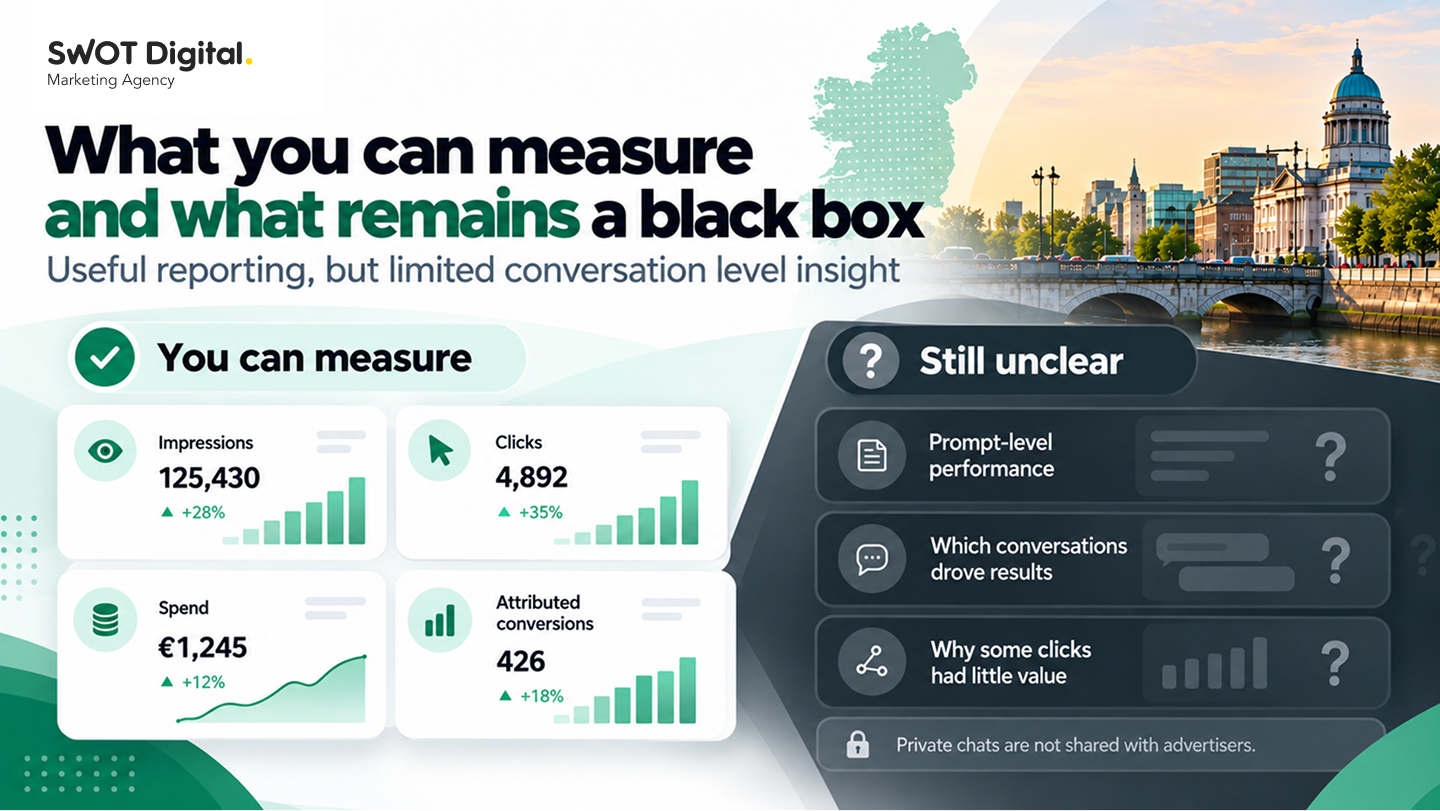
This is probably the biggest issue I have with the platform at the moment. The current reporting does not give advertisers a prompt-level performance report, and OpenAI does not share users’ private conversations with advertisers.
This is black box stuff, akin to Google’s Performance Max, or PMax, a few years ago.
That creates a significant degree of uncertainty when you are trying to understand performance.
ChatGPT Ads Manager does provide useful metrics such as impressions, clicks, spend and, where conversion measurement is configured, attributed conversions. Those results can be reviewed at campaign, ad group and individual ad level.
But there is an important distinction between measuring an outcome and understanding the conversation that led to it. Knowing that an ad generated five enquiries is useful. Knowing which types of conversations produced those enquiries, and which produced clicks of little value, would help us make better decisions about what to change.
There is still plenty we can do. We can test different messages, improve landing pages, change campaign structure and assess the quality of the enquiries being generated. But I would be wary of anyone claiming to know exactly why a particular ChatGPT Ads campaign worked when the underlying conversation data is not available.
And to be clear, I do not think advertisers should be able to read private chats. What I would welcome is more aggregated information about the types of situations and conversations producing results, without exposing the conversations themselves.
For now, that is the black box we have to work in.
Would I recommend testing ChatGPT Ads?
For an eligible business with a clear offering, suitable measurement, and a budget it can justify, yes. I think a focused test can make sense. I would not automatically divert money away from campaigns that are already producing tangible results.
My starting point would be a specific product or service, rather than trying to promote everything a business does. I would want a clear message, a relevant landing page and an agreed definition of what constitutes a worthwhile enquiry.
Measurement also needs to go beyond recording that somebody completed a form. Was the enquiry relevant? Was the person looking for something the business actually provides? Did it progress into a useful conversation? Did it turn into a sale?
Our own early enquiry is a reason to keep investigating the platform. It is not a benchmark I would apply to somebody else’s business. Before starting a campaign, I would agree what evidence would justify continuing, increasing investment or stopping.
How SWOT Digital can help
At SWOT Digital, we start with your business goals, your budget, and what would make ChatGPT Ads commercially worthwhile for you. We can check your eligibility, identify a suitable campaign to test, and develop context hints around the needs, questions, and buying decisions relevant to your services. We then set up the ads and conversion tracking, and assess the quality of the enquiries generated to establish whether the channel can deliver value for your business.
If you are interested in testing ChatGPT Ads, get in touch with SWOT Digital today.