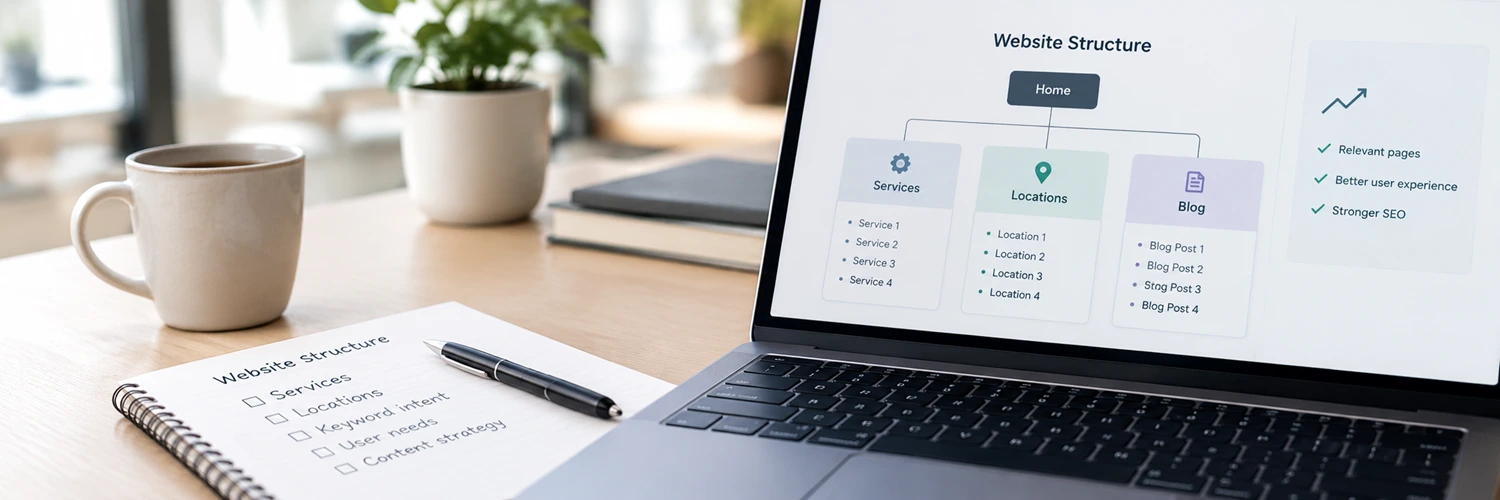
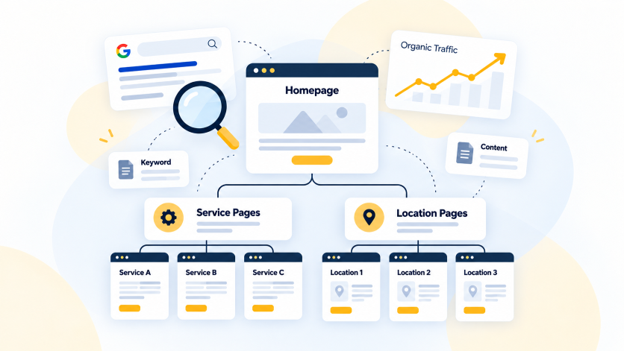
A business offering several services across multiple locations could easily end up with dozens of landing pages. One for every service, another for each variation, and then individual pages targeting all the towns and areas it covers.
On a sitemap, that might look like a comprehensive SEO strategy. But open a few of those pages, and you may find that much of the content is almost identical.
The opposite can also be a problem. Some businesses have several distinct services squeezed onto one general page, leaving customers with very little information about what each involves.
When we’re planning website content, one of the first things I want to establish is whether each proposed page has a clear purpose. Finding relevant keywords is important, but it doesn’t automatically mean we need a separate URL for every one of them.
We need to consider what the business provides, how people search for those services and whether the existing website already covers the subject. Sometimes creating new pages is the right decision. Other times, improving or combining existing content makes more sense.
Start With the Service, Not the Keyword
I usually begin by looking at what the business actually offers before getting too caught up in keyword variations.
Take a locksmith company providing residential, commercial and vehicle locksmith services.
These services can involve different customers, different types of work and different questions before someone gets in touch. Dedicated pages give the business room to explain what each service covers and help visitors find the information that’s relevant to them.
Someone looking for a residential locksmith may want to know what types of property work the company handles and how a visit is arranged.
Someone looking for an auto locksmith will have different questions about vehicle access, keys and whether the company can help with their particular situation.
Those differences provide a good reason to create separate pages.
But what about “emergency locksmith” and “24 hour locksmith”?
If the business provides the same emergency service around the clock, two separate pages could end up covering much of the same information.
I’d want to establish whether these are genuinely different offerings, what customers expect from each search and whether there’s enough useful information to support both pages. I’d also confirm the actual operating hours before describing a service as 24 hour.
What Justifies a Separate Service Page?
Before recommending a new page, there are a few things I look for:
- A genuinely different service: Does the business offer something distinct, or is it another way of describing an existing service?
- Different customer requirements: Would someone searching for this service have questions or concerns that aren’t adequately addressed on the current page?
- Enough specific information: Can we explain the work in detail, include relevant examples and answer useful questions without repeating another page?
- A clear place in the website: Would the new page make it easier for visitors to find what they need, or simply add another route to the same information?
Dedicated service pages also ranked first among the factors experts considered most important for local organic search in Whitespark’s 2026 Local Search Ranking Factors survey. That supports the value of giving important services their own properly developed pages, but it doesn’t mean creating a separate page for every keyword variation.
How Keyword Research Helps Us Make the Decision
Keyword research helps identify opportunities, but search volume alone doesn’t determine the website structure.
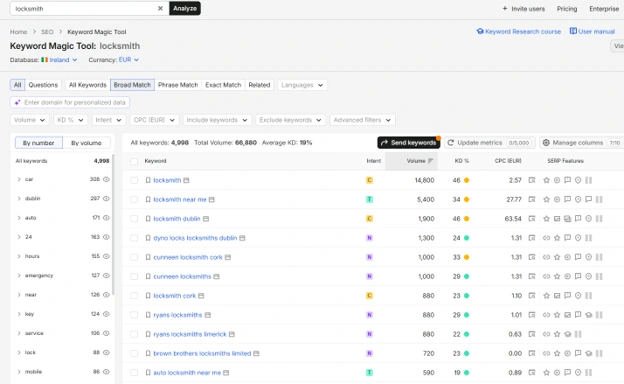
In Semrush’s Keyword Magic Tool, we can start with a term such as “locksmith”, select the Irish database and explore related searches.
Search volume gives us an estimate of demand, while keyword difficulty helps assess how competitive a particular term is likely to be.
Search intent is useful too. It helps distinguish informational searches from commercial searches, where someone is researching services or providers, and transactional searches, where they’re closer to taking action. These labels are helpful for organising the research, but they don’t make the content decision for us.
Someone searching for “how much does a locksmith cost Ireland” is probably looking for pricing information. A supporting article could explain what affects the cost and what to check when requesting a quotation, helping the reader compare their options.
“Locksmith Dublin”, on the other hand, suggests someone looking for a local provider. That belongs on a commercial page, such as the main locksmith service page for Dublin, rather than in an informational article.
However, I wouldn’t rely entirely on the intent labels provided by a tool. We still need to examine the actual search results.
When Similar Keywords Need Different Pages
Take “auto locksmith” and “car locksmith”.
Both may describe the same service. I’d compare the organic search results, looking at which URLs rank for each term and how much the results overlap.
If many of the same types of pages appear for both searches, and the business uses both terms for the same offering, one page can address them naturally.
Now consider residential and commercial locksmith services.
These searches target different customers. Someone arranging work at home is likely to have different requirements from someone organising locksmith work at commercial premises.
For a business offering distinct residential and commercial services, I’d recommend dedicated pages where there is enough useful information to address each audience properly. Simply changing “homeowners” to “businesses” in otherwise identical paragraphs wouldn’t be enough.
Service Page Decisions in Practice
| Proposed Content | What I’d Check | Possible Approach |
|---|---|---|
| Auto Locksmith and Car Locksmith | Do both terms refer to the same service offered by the business? | One page covering both terms if the service is the same |
| Emergency Locksmith and 24 Hour Locksmith | Is this the same service, with 24 hour availability? | One page if both searches relate to the same offering |
| Residential Locksmith and Commercial Locksmith | Are there different audiences, requirements and types of work? | Separate pages where the offerings differ |
| Residential Locksmith and Auto Locksmith | Are these clearly different services for different customer needs? | Separate service pages |
| Locksmith Costs | Does the subject need more detail than can reasonably sit on the service page? | Keep essential pricing information on the service page and use a supporting article where more explanation is useful |
There’s no fixed percentage of overlapping search results that tells us whether to create one page or two. The search results, the services offered and the information available all influence the decision.
When Location Pages Become Repetitive
The same decision applies to location pages.
A company serving Dublin and surrounding counties might naturally want to appear in searches for those locations. Local searches can be commercially valuable, particularly for businesses that travel to customers.
The issue is how those pages are created.
Imagine a website with separate pages for several neighbouring towns. Each has its own URL and heading, but the service descriptions, company benefits and contact information remain almost identical.
In some cases, the only meaningful difference is the location name.
The business is targeting different geographic searches, but someone visiting those pages learns very little about the service in their particular area.
If the business provides the same service in each area, there’s no need to make it sound different on every location page. I’d focus instead on adding useful local details where available, such as examples of completed work, customer feedback or practical information about arranging the service.
If there’s little to distinguish one town page from another, I’d question whether individual pages are the best approach.
Does Similar Content Cause a Google Penalty?
Having similar information across multiple pages isn’t automatically an SEO problem or a violation of Google’s policies.
A company will naturally repeat details about its services, processes and other standard information. There’s no reason to rewrite every description simply to make the wording different.
Google can also group pages with similar content and select the version it considers most representative. That can affect which URL appears in search results without indicating that the website has received a spam penalty.
The greater concern is creating numerous pages primarily to target similar searches without providing meaningful additional value.
Google addresses this in its Search Spam Policies, particularly the guidance on doorway abuse. Its examples include pages targeting different cities or regions that funnel visitors towards the same destination, as well as substantially similar pages created primarily to capture related searches.
A legitimate location page isn’t automatically a doorway page because some wording appears elsewhere on the website. The question is whether the page is genuinely useful or has mainly been created to capture another variation of the same search.
Service Area Pages vs Physical Location Pages
Before recommending location pages, I also look at how the business serves its customers.
There’s an important difference between a company that travels to customers across several towns and one that operates physical branches or premises where customers can visit.
Both can benefit from location specific content, but the information people need is different.
| Service Area Page | Physical Location Page | |
|---|---|---|
| What it represents | A town or region where the business provides services at customers’ properties | A genuine branch, office or premises where customers can visit |
| Customer questions | Does the company cover my area? Which services are available? How do I arrange a visit or quotation? | Where is the business located? What are the opening hours? Can I visit or book an appointment? |
| Useful content | Services available locally, completed projects, relevant feedback and enquiry details | Address, directions, opening hours, facilities, photographs and services available at that location |
| What to avoid | Suggesting the business has local premises when it simply serves the area | Implying customers can visit a location that isn’t genuinely available to them |
A business doesn’t need an office in every town it serves to have a relevant service area page. If it regularly works in a particular location, the page can explain what’s available there and provide useful information about arranging the service.
For a business with several physical locations, customers may need opening hours, directions, appointment information and details of what each premises offers.
There’s also an important distinction between website pages and Google Business Profiles. Publishing a page targeting a town doesn’t establish a physical business location there or automatically qualify the company for an additional Business Profile. Google’s rules for service area businesses are based on how and where the business actually operates.
When a Broader Regional Page Makes More Sense
For businesses covering multiple towns, I’d consider whether a regional page would provide a clearer structure.
Instead of creating an individual page for every suburb, a business could have a page covering South Dublin, for example, with the relevant towns mentioned naturally.
That page could explain the services available throughout the area and link to the appropriate service pages.
Where a particular town has sufficient search demand, useful local information and a clear purpose, a separate page can still be worthwhile.
The decision depends on service coverage, the search results, competition and the performance of any existing pages. The structure should reflect how the business operates rather than attempting to accommodate every location keyword.
Review Existing Page Performance Before Making Changes
When reviewing an established website, I wouldn’t recommend removing a page simply because its target keywords have low reported search volumes.
Keyword tools provide estimates. They don’t tell us everything about how a page performs.
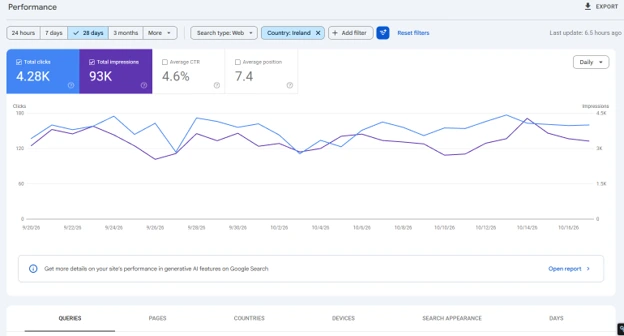
Google Search Console allows us to examine impressions, clicks and the queries generating visibility. For a business primarily serving Ireland, I’d normally apply the appropriate country filter to keep the analysis relevant. Search Console also notes that filtering by URL or query can affect totals because some query data is omitted.
GA4 adds another perspective. Its Landing Page report shows the pages where sessions began and can include properly configured key events, which helps us assess whether visitors are taking actions that matter to the business.
A page with relatively modest traffic might still generate valuable leads. Another page attracting considerably more visitors might contribute very little to the business.
I’d also review its content, internal links, backlinks and relationship with other pages.
These findings can change the recommendation considerably. It’s not a decision I’d make from a keyword export alone.
When Keyword Cannibalisation Becomes a Problem
Keyword cannibalisation is another potential issue when multiple pages target substantially the same search intent.
For example, two service pages might target closely related search terms while describing exactly the same offering and answering the same customer questions.
If a less relevant page keeps appearing for an important search, or different URLs repeatedly exchange rankings while overall performance suffers, there may be a case for making changes.
However, two pages ranking for the same keyword don’t automatically indicate harmful cannibalisation.
A general service page and a more specific supporting page could both appear for related searches while providing different information.
An Ahrefs study of multiple rankings offers an interesting example. After reviewing a sample of 80 keywords for which its own website had multiple ranking pages, the researcher identified only one case that needed action. It’s a limited sample from one website, but it illustrates why overlapping rankings shouldn’t automatically trigger changes.
I’d compare the queries, ranking pages, performance over time and purpose of each URL before recommending a solution.
Sometimes the pages simply need clearer roles and better internal linking. In other cases, consolidating them makes more sense.
Improve an Existing Page or Create a New One?
Not every keyword opportunity requires another page.
An existing service page might already appear for several related searches but only briefly address some of the questions behind them.
Before recommending additional pages, I’d look at whether the existing content could be improved.
That might involve explaining particular aspects of the service in more detail, clarifying what’s included, adding relevant project examples or answering questions that customers regularly ask.
If there’s a separate informational topic worth covering, a supporting article could provide the additional detail without duplicating the main service page.
I’d also consider whether the existing page is attracting the right searches and whether the proposed changes fit its main purpose.
Sometimes expanding a page is the sensible option. Other times, the research reveals a distinct service or customer requirement that genuinely deserves its own page.
Before You Delete or Redirect Existing Pages
Identifying overlapping pages is one thing. Deciding what to do with them requires more care.
Before recommending that a page be removed or combined with another, I’d check:
- Organic performance: Does it attract relevant clicks, impressions or rankings?
- Enquiries: Does it contribute valuable leads or other actions?
- Backlinks: Are other websites linking to it?
- Content: Is there useful information worth preserving?
- Replacement: Is there a suitable page that addresses the same or a closely related need?
If two pages overlap substantially, we might combine their strongest content into one more useful page.
Where an old URL has a relevant replacement, a permanent redirect helps users and search engines find it. Google also lists consolidating several pages into one as a legitimate use of redirects.
Redirecting every unwanted page to the homepage isn’t a good default. Redirecting individual town pages to a broader regional page can make sense, though, provided that page covers those locations, offers the same services and gives visitors the information they were looking for.
If no suitable replacement exists, returning an appropriate not found response is generally preferable to sending users to an unrelated page. Google recommends a permanent redirect where content has a clear replacement and a proper 404 where it doesn’t.
Internal links, navigation and XML sitemaps should also be updated where necessary.
I’d then monitor organic performance rather than assume reducing the number of URLs will automatically improve rankings.
A Simple Test Before Creating Another Page
By the time we’re ready to finalise a sitemap, I want to be able to explain why each proposed page deserves to exist.
That’s an important part of how we approach our SEO services. Keyword research identifies opportunities, but we still need to decide which pages are worth creating, which need improving and how everything should work together.
If you’re unsure whether your website has too many similar pages, open three or four targeting related services or neighbouring locations.
Read them side by side, paying attention to the service descriptions, customer questions and practical information. Then imagine removing the headings and location names.
Would the pages still be clearly different? Could a customer learn something important from one that isn’t available on the others? Or could most of the content be combined without losing anything useful?
Not sure which service or location pages your website needs? Speak to our SEO team. We’ll help you identify where new pages would be useful, which existing pages need attention and whether overlapping content is worth combining.